
CEATECメインビジュアル-e1791524947269.png)
Pioneering a New Era of Heat Sensing with Topological Materials
TopoLogic aims to realize a next-generation energy society powered by advanced thermal management. By harnessing the unique physical phenomena of topological materials, we are developing technology that detects heat flow—previously difficult to measure—with high speed and sensitivity.
At CEATEC 2026, we will showcase TL-SENSING™, the world’s first heat flux sensor based on topological materials (*). * Source: TopoLogic’s own research, October 2026
Exhibition
CEATEC 2026
[Dates] 13 October (Tuesday) – 16 October (Friday) 2026, 10:00–17:00
[Venue] Makuhari Messe
[Exhibition Stands]Next Generation Park Hall 4|Booth4H141
https://www.ceatec.com/nj/exhibitor_detail_en?id=276
[Admission] Free *Online registration is required.
Pre-registration page
https://reg.ceatec.com/?act=Form&event_id=33&quantity%5B87%5D=1&func=Payment&code=ceatec

What Are Topological Materials?
Topological materials are a new class of materials characterized by electronic band structures that differ from those of conventional materials, giving rise to unique physical phenomena not observed in conventional materials.
TopoLogic harnesses the distinctive properties of these materials to develop innovative applications across a wide range of industries.
Two Physical Phenomena Enabled by Topological Materials
The foundation of TopoLogic’s technology lies in two physical phenomena whose understanding has advanced through topological quantum theory: the anomalous Hall effect and the anomalous Nernst effect.
Around singularities in topological materials, effective magnetic fields equivalent to hundreds of tesla can emerge. Under the influence of these effective fields, electrons exhibit unique behavior not found in other classes of materials.
One such phenomenon is the anomalous Nernst effect, in which a voltage is generated directly in the direction perpendicular to heat flow.
By harnessing this effect, it becomes possible to directly detect heat flux—the direction and magnitude of heat flow—rather than merely measuring temperature, the resulting state of a thermal process.
Heat Flux Sensor TL-SENSING™
TL-SENSING™ is the world’s first heat flux sensor based on topological materials designed for seamless integration into electronic systems (*). *Source: TopoLogic’s own research, October 2026
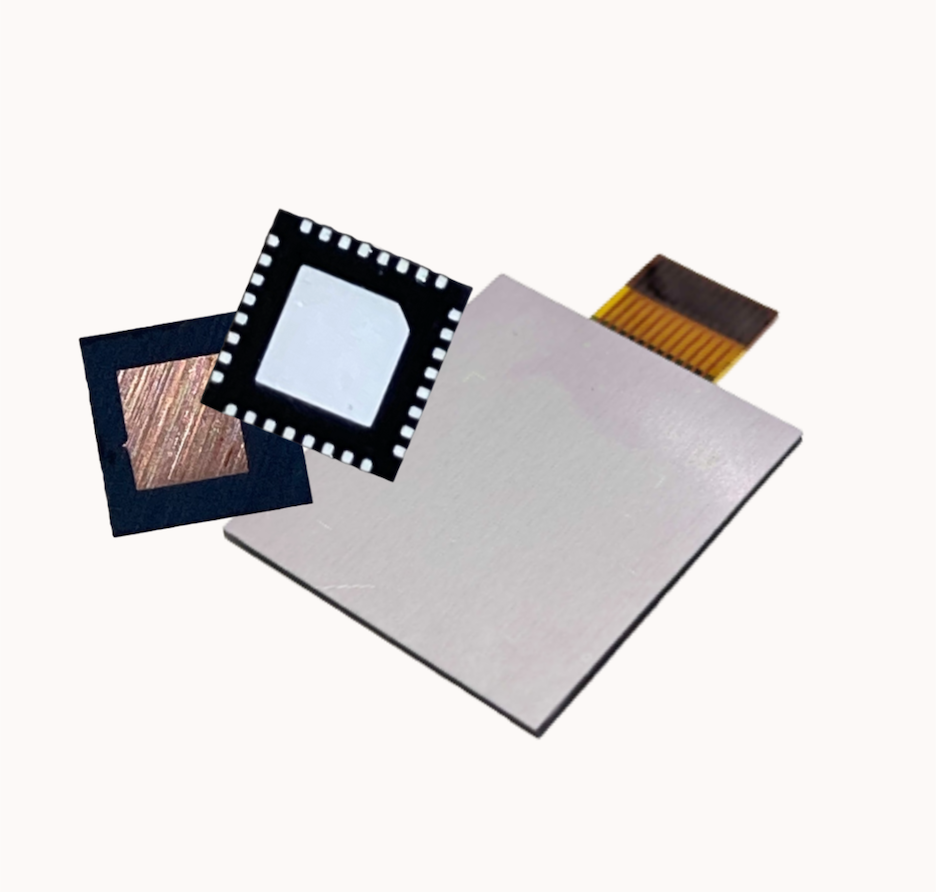
In addition to its fast response time, enabling heat flow detection on a millisecond timescale, TL-SENSING™ features a compact, thin design with dimensions ranging from mm² to cm², as well as an integration-ready design suited for mass production.
Conventional temperature sensors detect the result of a temperature increase. With TL-SENSING™, it becomes possible to capture the process behind that increase: how heat flows in real time.
Just as an acceleration sensor measures changes in velocity, complementing a speed sensor, TL-SENSING™ is a heat flux sensor that captures changes in heat flow, complementing conventional temperature sensors.
Four New Possibilities Beyond Heat Detection
By integrating TL-SENSING™ into a wide range of devices and systems, we aim to unlock new capabilities powered by heat sensing.
CEATECメインビジュアル-1-1024x323.png)
1. Real-Time Heat Flow Detection
By detecting changes in heat flow within milliseconds, TL-SENSING™ can rapidly identify sudden increases in heat generation.
- Battery overheating and runaway detection
- Abnormal heat generation detection in electronic devices
TL-SENSING™ offers the potential for early detection of anomalies in batteries and electronic devices, where safety is critical.
2. Continuous Monitoring at Multiple Points
By deploying multiple TL-SENSING™ sensors, whose compact, thin design makes them easy to integrate, it becomes possible to continuously monitor heat distribution—something that has been difficult to achieve with conventional approaches.
- Heat management in data centers
- Detection of Hydrogen Leaks via Heat Flow
By leveraging data collected from multiple sensors, localized anomalies can be identified, enabling more detailed and comprehensive condition monitoring.
3. Early Anomaly Detection and Feedforward Control
By detecting changes in heat flow at an early stage, TL-SENSING™ has the potential to enable predictive control strategies that anticipate changes, rather than simply responding after an anomaly occurs.
- Battery management
- Healthcare management
By connecting detected information to subsequent control actions, rather than simply detecting changes, TL-SENSING™ opens up new possibilities for system design.
4. Bringing a Sense of Heat to Humans and Robots
Heat sensing technology has the potential to extend human sensory capabilities to machines.
- Heat sensing for remote operators
- A sense of heat for humanoid robots
By adding heat as a new source of sensory information to what has traditionally been perceived through vision and touch, TL-SENSING™ has the potential to create new value in human-machine interaction.
Bringing Topological Materials into Real-World Applications
At TopoLogic, we aim to bring the unique physical properties of topological materials into practical industrial applications through a business model built around engineering and IP licensing / revenue sharing.
We are currently conducting proof-of-concept (PoC) projects with multiple partners, exploring potential applications across a wide range of fields, including batteries, electronic devices, energy, and data centers.
Detecting heat. Transforming heat into a new source of information.
A new sensing technology born from topological materials has the potential to transform the future of industries across the board.
Visit the TopoLogic booth at CEATEC 2026 to discover the potential of TL-SENSING™.
Heat Flux Sensor TL-SENSING™ – Demo Video
The Difference Between Heat Flux Sensors and Thermometer
“Heat” = A type of energy alongside electrical energy, mechanical energy, etc.
“Temperature” = An indicator representing the state altered by the transfer or flow of thermal energy
This image illustrates the difference between a “heat flux sensor” and a “thermometer” when heating a metal plate.
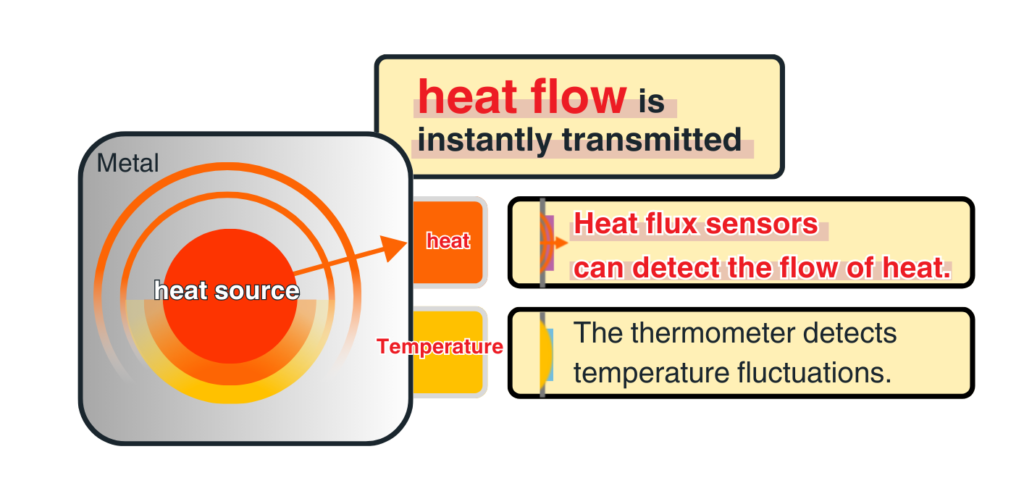
As shown in the figure, the heat flow sensor instantly detects the flow of heat. On the other hand, the thermometer detects temperature fluctuations.
Demo Movie
Located a heater on the center of the PCB, a thermometer on its left and TL-SENSING on its right. As heat is generated from the heater and transferred to two sensors, we monitored the reaction.
▼Heat Flux Sensor TL-SENSING™ (QFN Package) Demo Movie
※The speed at which heat is transmitted to each sensor is the same across the entire substrate.
▼Demo results
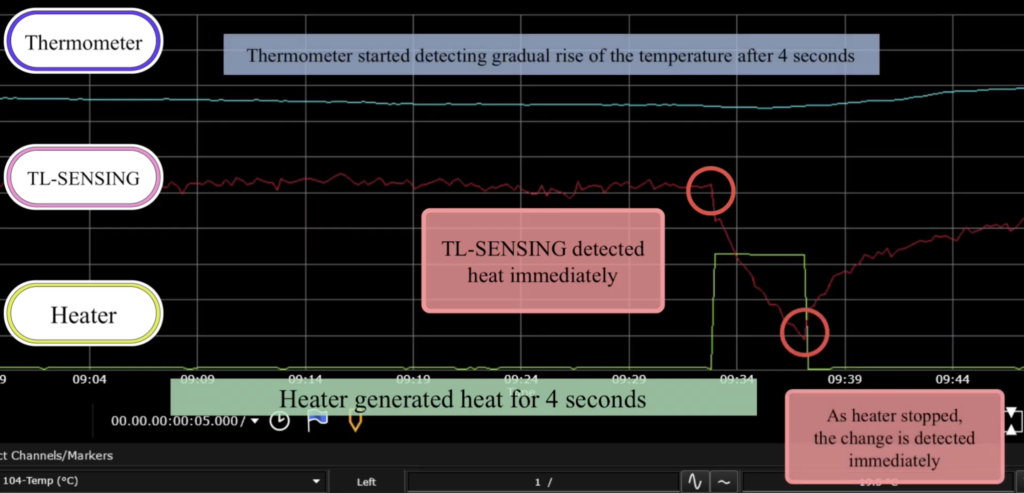
Heat Flux Sensor TL-SENSING™
TL-SENSING detected heat immediately.
As heater stopped generating heat, TL-SENSING detected the heat reduction immediately.
Thermometer
Thermometer started detecting gradual rise in the temperature. Thermometer hit the highest temperature after 15 seconds.
The temperature rose gradually because of heat flowing, the movement of heat cannot be detected instantaneously.

コメント